> ## Documentation Index
> Fetch the complete documentation index at: https://bifrost-backport-mcp-oauth2-server.mintlify.site/llms.txt
> Use this file to discover all available pages before exploring further.
# OpenAI
> OpenAI API conversion guide - what to know when using OpenAI through Bifrost
## Overview
OpenAI is the **baseline schema** for Bifrost. When using OpenAI directly, parameters are passed through with minimal conversion - mostly validation and filtering of OpenAI-specific features.
### Supported Operations
| Operation | Non-Streaming | Streaming | Endpoint |
| - | - | - | - |
| Chat Completions | ✅ | ✅ | `/v1/chat/completions` |
| Responses API | ✅ | ✅ | `/v1/responses` |
| Responses Lifecycle | ✅ | ✅ | `/v1/responses/{response_id}` |
| Text Completions | ✅ | ✅ | `/v1/completions` |
| Embeddings | ✅ | - | `/v1/embeddings` |
| Speech (TTS) | ✅ | ✅ | `/v1/audio/speech` |
| Transcriptions (STT) | ✅ | ✅ | `/v1/audio/transcriptions` |
| Image Generation | ✅ | ✅ | `/v1/images/generations` |
| Image Edit | ✅ | ✅ | `/v1/images/edits` |
| Image Variation | ✅ | - | `/v1/images/variations` |
| Files | ✅ | - | `/v1/files` |
| Batch | ✅ | - | `/v1/batches` |
| Video Generation | ✅ | - | `/v1/videos` |
| Context Compaction | ✅ | - | `/v1/responses/compact` |
| List Models | ✅ | - | `/v1/models` |
## Setup & Configuration
Configure OpenAI as a provider.
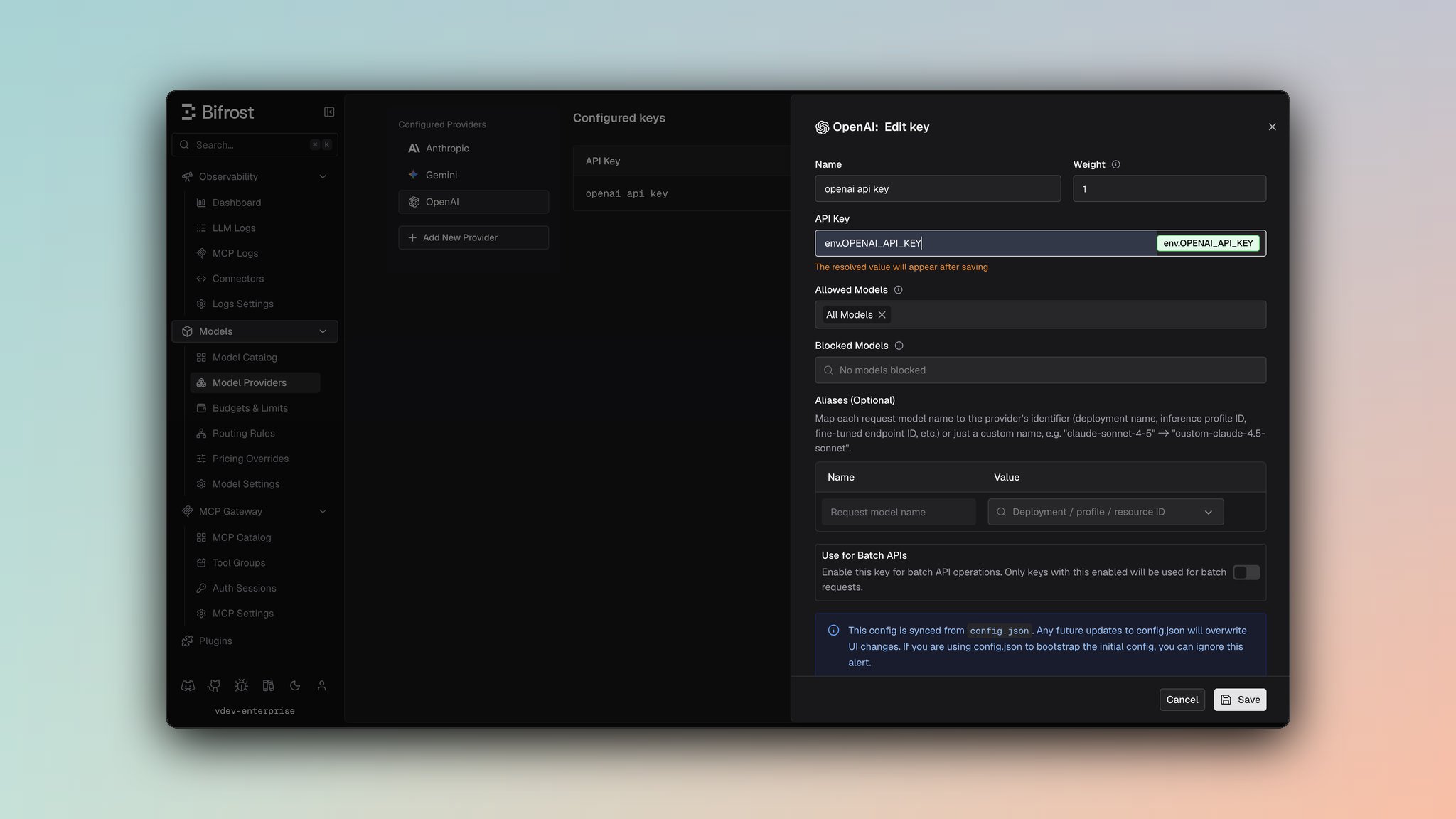 1. Navigate to **Models** > **Model Providers**. Look for **OpenAI** under **Configured Providers**. If it is missing, click on **Add New Provider** and select **OpenAI**.
2. Click **Add Key** or edit an existing key.
3. Set a name for your key.
4. Paste your API key directly or use an environment variable (for example, `env.OPENAI_API_KEY`).
5. Set **Allowed Models** to **All Models** (default) or the specific model allowlist you want this key to serve.
6. Save the provider configuration.
```json theme={null}
{
"providers": {
"openai": {
"keys": [
{
"name": "openai-key-1",
"value": "env.OPENAI_API_KEY",
"models": [
"*"
],
"weight": 1.0
}
],
"openai_config": {
"disable_store": false
}
}
}
}
```
Refer to the API documentation for [Provider Keys Management](https://docs.getbifrost.ai/api-reference/providers/create-a-key-for-a-provider).
```go theme={null}
case schemas.OpenAI:
return []schemas.Key{{
Name: "openai-key-1",
Value: *schemas.NewSecretVar("env.OPENAI_API_KEY"),
Models: []string{"*"},
Weight: 1.0,
}}, nil
```
Optional provider settings include `network_config` for timeouts, retries, proxy/TLS settings, and `openai_config.disable_store` to force `store=false` on outgoing OpenAI requests.
***
# 1. Chat Completions
**Request Parameters**
| Parameter | Type | Required | Notes |
| - | - | - | - |
| `model` | string | ✅ | Model identifier |
| `messages` | [array](https://github.com/maximhq/bifrost/blob/main/core/schemas/chatcompletions.go#L15) | ✅ | [`ChatMessage`](https://github.com/maximhq/bifrost/blob/main/core/schemas/chatcompletions.go#L370) array with roles ([docs](https://platform.openai.com/docs/api-reference/chat/create#chat-create-messages)) |
| `temperature` | float | ❌ | Sampling temperature (0-2) |
| `top_p` | float | ❌ | Nucleus sampling parameter |
| `stop` | string/array | ❌ | Stop sequences |
| `max_completion_tokens` | int | ❌ | Min 16, max output tokens |
| `frequency_penalty` | float | ❌ | Frequency penalty (-2 to 2) |
| `presence_penalty` | float | ❌ | Presence penalty (-2 to 2) |
| `logit_bias` | [object](https://github.com/maximhq/bifrost/blob/main/core/schemas/chatcompletions.go#L25) | ❌ | Token logit adjustments |
| `logprobs` | bool | ❌ | Include log probabilities |
| `top_logprobs` | int | ❌ | Number of log probabilities per token |
| `seed` | int | ❌ | Reproducibility seed |
| `response_format` | [object](https://github.com/maximhq/bifrost/blob/main/core/schemas/chatcompletions.go#L23) | ❌ | Output format ([docs](https://platform.openai.com/docs/api-reference/chat/create#chat-create-response_format)) |
| `tools` | [array](https://github.com/maximhq/bifrost/blob/main/core/schemas/chatcompletions.go#L21) | ❌ | [`Tool`](https://github.com/maximhq/bifrost/blob/main/core/schemas/chatcompletions.go#L600) objects ([docs](https://platform.openai.com/docs/api-reference/chat/create#chat-create-tools)) |
| `tool_choice` | string/[object](https://github.com/maximhq/bifrost/blob/main/core/schemas/chatcompletions.go#L22) | ❌ | `"auto"`, `"none"`, `"required"`, or specific tool |
| `parallel_tool_calls` | bool | ❌ | Allow multiple simultaneous tool calls |
| `stream_options` | [object](https://github.com/maximhq/bifrost/blob/main/core/schemas/chatcompletions.go#L26) | ❌ | Streaming options ([docs](https://platform.openai.com/docs/api-reference/chat/create#chat-create-stream_options)) |
| `reasoning` | [object](https://github.com/maximhq/bifrost/blob/main/core/schemas/chatcompletions.go#L24) | ❌ | Reasoning parameters ([Bifrost docs](/providers/reasoning), [OpenAI docs](https://platform.openai.com/docs/api-reference/chat/create#chat-create-reasoning)) |
| `user` | string | ❌ | **Truncated to 64 chars** |
| `metadata` | [object](https://github.com/maximhq/bifrost/blob/main/core/schemas/chatcompletions.go#L27) | ❌ | Custom metadata |
| `store` | bool | ❌ | **Filtered for non-OpenAI routing** |
| `service_tier` | string | ❌ | **Filtered for non-OpenAI routing** |
| `prompt_cache_key` | string | ❌ | **Filtered for non-OpenAI routing** |
| `prediction` | [object](https://github.com/maximhq/bifrost/blob/main/core/schemas/chatcompletions.go#L28) | ❌ | Predicted output for acceleration |
| `audio` | [object](https://github.com/maximhq/bifrost/blob/main/core/schemas/chatcompletions.go#L29) | ❌ | Audio output config |
| `modalities` | [array](https://github.com/maximhq/bifrost/blob/main/core/schemas/chatcompletions.go#L30) | ❌ | Response modalities (text, audio) |
***
* **Reasoning:** OpenAI supports `reasoning.effort` (`minimal`, `low`, `medium`, `high`) and `reasoning.max_tokens` - both passed through directly. When routing to other providers, `"minimal"` effort is converted to `"low"` for compatibility. See [Bifrost reasoning docs](/providers/reasoning).
* **Messages:** All message roles are supported: `system`, `user`, `assistant`, `tool`, `developer` (treated as system). Content types: text, images via URL (`image_url`), audio input (`input_audio`). Tool messages include a `tool_call_id`.
* **Tools:** Standard OpenAI tool format with strict mode support. Tool choice: `"auto"`, `"none"`, `"required"`, or specific tool by name.
* **Responses:** Passed through in standard OpenAI format. Finish reasons: `stop`, `length`, `tool_calls`, `content_filter`. Usage includes token counts and optionally cached/reasoning token details.
* **Streaming:** Server-Sent Events format with `delta.content`, `delta.tool_calls`, `finish_reason`, and `usage` (final chunk only, automatically included by Bifrost). `stream_options: { include_usage: true }` is set by default for all streaming calls.
* **Cache Control:** `cache_control` fields are stripped from messages, their content blocks, and tools before sending. The exception is the **gpt-5.6 family**, where a marked text block is translated into OpenAI's own `prompt_cache_breakpoint` and the request is switched to `prompt_cache_options.mode: "explicit"`. Those models default to implicit caching, which anchors the cached prefix to the newest message and bills a cache write every turn; explicit mode pins it. Earlier models have no such field, so stripping remains correct for them. Bifrost can also add the marker for clients that send none - see [Prompt caching](/features/prompt-caching).
* **Token Enforcement:** `max_completion_tokens` is enforced to have a minimum of 16. Values below 16 are automatically set to 16.
* **Special handling:** `user` field is truncated to 64 characters; `prompt_cache_key`, `store`, `service_tier` are filtered when routing to non-OpenAI providers
***
# 2. Responses API
The Responses API is OpenAI's structured output API.
**Request Parameters**
| Parameter | Type | Required | Notes |
| - | - | - | - |
| `model` | string | ✅ | Model identifier |
| `input` | string/[array](https://github.com/maximhq/bifrost/blob/main/core/schemas/responses.go#L40) | ✅ | Text or [`ContentBlock`](https://github.com/maximhq/bifrost/blob/main/core/schemas/responses.go#L500) array ([docs](https://platform.openai.com/docs/api-reference/responses/create#responses-create-input)) |
| `max_output_tokens` | int | ✅ | Maximum output length |
| `background` | bool | ❌ | Run request in background mode |
| `conversation` | string | ❌ | Conversation ID for continuing a conversation |
| `include` | array | ❌ | Array of fields to include in response (e.g., `"web_search_call.action.sources"`) |
| `instructions` | string | ❌ | System instructions |
| `max_tool_calls` | int | ❌ | Maximum number of tool calls |
| `metadata` | [object](https://github.com/maximhq/bifrost/blob/main/core/schemas/responses.go#L94) | ❌ | Custom metadata |
| `parallel_tool_calls` | bool | ❌ | Allow multiple simultaneous tool calls |
| `previous_response_id` | string | ❌ | ID of previous response to continue from |
| `prompt_cache_key` | string | ❌ | Prompt caching key |
| `reasoning` | [object](https://github.com/maximhq/bifrost/blob/main/core/schemas/responses.go#L238) | ❌ | [`ResponsesParametersReasoning`](https://github.com/maximhq/bifrost/blob/main/core/schemas/responses.go#L238) configuration ([Bifrost docs](/providers/reasoning)) |
| `safety_identifier` | string | ❌ | Safety identifier for content filtering |
| `service_tier` | string | ❌ | Service tier for the request |
| `stream_options` | [object](https://github.com/maximhq/bifrost/blob/main/core/schemas/responses.go#L116) | ❌ | [`ResponsesStreamOptions`](https://github.com/maximhq/bifrost/blob/main/core/schemas/responses.go#L116) configuration |
| `store` | bool | ❌ | Store the response for later retrieval |
| `temperature` | float | ❌ | Sampling temperature |
| `text` | [object](https://github.com/maximhq/bifrost/blob/main/core/schemas/responses.go#L120) | ❌ | [`ResponsesTextConfig`](https://github.com/maximhq/bifrost/blob/main/core/schemas/responses.go#L120) for output formatting |
| `top_logprobs` | int | ❌ | Number of log probabilities to return per token |
| `top_p` | float | ❌ | Nucleus sampling parameter |
| `tool_choice` | string/[object](https://github.com/maximhq/bifrost/blob/main/core/schemas/responses.go#L969) | ❌ | [`ResponsesToolChoice`](https://github.com/maximhq/bifrost/blob/main/core/schemas/responses.go#L969) strategy |
| `tools` | [array](https://github.com/maximhq/bifrost/blob/main/core/schemas/responses.go#L1050) | ❌ | [`ResponsesTool`](https://github.com/maximhq/bifrost/blob/main/core/schemas/responses.go#L1050) objects ([docs](https://platform.openai.com/docs/api-reference/responses/create#responses-create-tools)) |
| `truncation` | string | ❌ | Truncation strategy (`auto` or `off`) |
| `user` | string | ❌ | **Truncated to 64 chars** |
***
**Special Message Handling (gpt-oss vs other models):**
OpenAI models handle reasoning differently depending on the model family:
* **Non-gpt-oss models** (GPT-4o, o1, etc.): Send reasoning as **summaries**. Reasoning-only messages (with no summary and only content blocks) are filtered out since these models don't support reasoning content blocks in the request format.
* **gpt-oss models**: Send reasoning as **content blocks**. Reasoning summaries in the request are converted to content blocks since gpt-oss expects reasoning as structured blocks, not summaries.
This conversion ensures compatibility across different model architectures for the structured Responses API. See [Bifrost reasoning docs](/providers/reasoning) for detailed reasoning handling.
**Token & Parameter Enforcement:**
* `max_output_tokens` is enforced to have a minimum of 16. Values below 16 are automatically set to 16.
* `reasoning.max_tokens` field is automatically removed from JSON output (OpenAI Responses API doesn't accept it).
**Other conversions:**
* Action types `zoom` and `region` are converted to `screenshot`
* `cache_control` fields are stripped from messages and tools
* Unsupported tool types are silently filtered (only these are supported: `function`, `file_search`, `computer_use_preview`, `web_search`, `mcp`, `code_interpreter`, `image_generation`, `local_shell`, `custom`, `web_search_preview`)
**Response:** Includes `id`, `status` (`completed`, `incomplete`, `pending`, `error`), `output` array with message content, and token `usage`.
**Streaming:** Server-Sent Events. `stream_options: { include_usage: true }` is set by default for all streaming calls. Each event carries a `type` field ([`ResponsesStreamResponseType`](https://github.com/maximhq/bifrost/blob/main/core/schemas/responses.go#L3039)) with one of the following values:
| Category | Event Types |
| - | - |
| Response lifecycle | `response.created`, `response.queued`, `response.in_progress`, `response.completed`, `response.failed`, `response.incomplete` |
| Output items & content | `response.output_item.added`, `response.output_item.done`, `response.content_part.added`, `response.content_part.done`, `response.output_text.delta`, `response.output_text.done` |
| Refusals & annotations | `response.refusal.delta`, `response.refusal.done`, `response.output_text.annotation.added`, `response.output_text.annotation.done` |
| Function & custom tool calls | `response.function_call_arguments.delta`, `response.function_call_arguments.done`, `response.custom_tool_call_input.delta`, `response.custom_tool_call_input.done` |
| File search | `response.file_search_call.in_progress`, `response.file_search_call.searching`, `response.file_search_call.results.added`, `response.file_search_call.results.completed` |
| Web search | `response.web_search_call.in_progress`, `response.web_search_call.searching`, `response.web_search_call.completed`, `response.web_search_call.results.added`, `response.web_search_call.results.completed` |
| Web fetch | `response.web_fetch_call.in_progress`, `response.web_fetch_call.fetching`, `response.web_fetch_call.completed` |
| Reasoning summaries | `response.reasoning_summary_part.added`, `response.reasoning_summary_part.done`, `response.reasoning_summary_text.delta`, `response.reasoning_summary_text.done` |
| Image generation | `response.image_generation_call.in_progress`, `response.image_generation_call.generating`, `response.image_generation_call.partial_image`, `response.image_generation_call.completed` |
| MCP | `response.mcp_call_arguments.delta`, `response.mcp_call_arguments.done`, `response.mcp_call.in_progress`, `response.mcp_call.completed`, `response.mcp_call.failed`, `response.mcp_list_tools.in_progress`, `response.mcp_list_tools.completed`, `response.mcp_list_tools.failed` |
| Code interpreter | `response.code_interpreter_call.in_progress`, `response.code_interpreter_call.interpreting`, `response.code_interpreter_call.completed`, `response.code_interpreter_call_code.delta`, `response.code_interpreter_call_code.done` |
| Keepalive & errors | `response.ping` (sent by few providers, e.g. Anthropic), `error` |
## Response Lifecycle
Manage stored and background responses after creation (requests made with `store: true` or `background: true`). All lifecycle operations accept an optional `provider` query parameter (defaults to `openai`); providers that do not implement these operations return an unsupported operation error.
When multiple API keys are configured for the provider, pin key selection on lifecycle calls (for example, with the `x-bf-api-key-id` header, see [Request Options](/providers/request-options)) so they hit the same upstream account as the create call that produced the `response_id`.
### Retrieve Response
GET `/v1/responses/{response_id}` - Retrieve a stored response ([docs](https://platform.openai.com/docs/api-reference/responses/get))
**Query Parameters**
| Parameter | Type | Required | Notes |
| - | - | - | - |
| `include` | array | ❌ | Additional fields to include (repeat the parameter for multiple values) |
| `starting_after` | int | ❌ | Sequence number of the event after which to start the response |
| `include_obfuscation` | bool | ❌ | Whether to include obfuscation on the response |
| `stream` | bool | ❌ | When `true`, replays the stored response as SSE events |
**Response:** The full response object, same shape as `POST /v1/responses`. With `stream=true`, the same SSE event stream as `POST /v1/responses` with `stream: true`.
### Delete Response
DELETE `/v1/responses/{response_id}` - Delete a stored response ([docs](https://platform.openai.com/docs/api-reference/responses/delete))
**Response:** [`BifrostResponsesDeleteResponse`](https://github.com/maximhq/bifrost/blob/main/core/schemas/responses.go#L126) with `id`, `object`, and `deleted: true`.
### Cancel Response
POST `/v1/responses/{response_id}/cancel` - Cancel an in-flight response ([docs](https://platform.openai.com/docs/api-reference/responses/cancel)). Only responses created with `background: true` can be cancelled.
**Response:** The full response object, same shape as `POST /v1/responses`.
### List Input Items
GET `/v1/responses/{response_id}/input_items` - List the input items of a response ([docs](https://platform.openai.com/docs/api-reference/responses/input-items))
**Query Parameters**
| Parameter | Type | Required | Notes |
| - | - | - | - |
| `after` | string | ❌ | Pagination cursor (item ID to list items after) |
| `include` | array | ❌ | Additional fields to include (repeat the parameter for multiple values) |
| `limit` | int | ❌ | Results per page |
| `order` | string | ❌ | asc or desc |
**Response:** [`BifrostResponsesInputItemsResponse`](https://github.com/maximhq/bifrost/blob/main/core/schemas/responses.go#L134) with `object: "list"`, `data` (array of input items), `has_more`, `first_id`, `last_id`. Cursor-based pagination with `has_more` flag.
***
# 3. Text Completions (Legacy)
Text Completions is a legacy API. Use Chat Completions for new implementations.
**Request Parameters**
| Parameter | Type | Required | Notes |
| - | - | - | - |
| `model` | string | ✅ | Model identifier |
| `prompt` | string/array | ✅ | Completion prompt(s) |
| `max_tokens` | int | ❌ | Maximum output tokens |
| `temperature` | float | ❌ | Sampling temperature |
| `top_p` | float | ❌ | Nucleus sampling |
| `stop` | string/array | ❌ | Stop sequences |
| `user` | string | ❌ | **Truncated to 64 chars** |
***
* Array prompts generate multiple completions. Finish reasons: `stop` or `length`. Streaming uses SSE format. `stream_options: { include_usage: true }` is set by default for streaming calls.
* `user` field is truncated to 64 characters or set to nil if it exceeds the limit.
***
# 4. Embeddings
**Request Parameters**
| Parameter | Type | Required | Notes |
| - | - | - | - |
| `model` | string | ✅ | Model identifier |
| `input` | string/[array](https://github.com/maximhq/bifrost/blob/main/core/schemas/embedding.go#L12) | ✅ | Text(s) to embed ([docs](https://platform.openai.com/docs/api-reference/embeddings/create#embeddings-create-input)) |
| `encoding_format` | string | ❌ | `float` or `base64` |
| `dimensions` | int | ❌ | Output embedding dimensions |
| `user` | string | ❌ | **NOT truncated** (unlike chat/text) |
***
* No streaming support. Returns [`embedding`](https://github.com/maximhq/bifrost/blob/main/core/schemas/embedding.go#L30) array with usage counts.
***
# 5. Speech (Text-to-Speech)
**Request Parameters**
| Parameter | Type | Required | Notes |
| - | - | - | - |
| `model` | string | ✅ | `tts-1` or `tts-1-hd` |
| `input` | string | ✅ | Text to convert to speech |
| `voice` | string | ✅ | alloy, echo, fable, onyx, nova, shimmer |
| `response_format` | string | ❌ | mp3, opus, aac, flac, wav, pcm |
| `speed` | float | ❌ | 0.25 to 4.0 (default 1.0) |
***
* Returns raw binary audio. Streaming supported in SSE format (base64 chunks), but not all models support streaming. `stream_options: { include_usage: true }` is set by default for streaming calls.
***
# 6. Transcriptions (Speech-to-Text)
Requests use **multipart/form-data**, not JSON.
**Request Parameters**
| Parameter | Type | Required | Notes |
| - | - | - | - |
| `file` | binary | ✅ | Audio file (multipart form-data) |
| `model` | string | ✅ | `whisper-1` |
| `language` | string | ❌ | ISO-639-1 language code |
| `prompt` | string | ❌ | Optional prompt for context |
| `temperature` | float | ❌ | Sampling temperature |
| `response_format` | string | ❌ | json, text, srt, vtt, verbose\_json |
***
* **Supported audio formats:** mp3, mp4, mpeg, mpga, m4a, wav, webm
* **Response:** Includes `text`, `task`, `language`, `duration`, and optionally word-level timing. Streaming supported in SSE format. `stream_options: { include_usage: true }` is set by default for streaming calls.
***
# 7. Image Generation
**Request Parameters**
| Parameter | Type | Required | Notes |
| - | - | - | - |
| `model` | string | ✅ | Model identifier (e.g., `dall-e-3`) |
| `prompt` | string | ✅ | Text description of the image to generate |
| `n` | int | ❌ | Number of images to generate (1-10) |
| `size` | string | ❌ | Image size: `"256x256"`, `"512x512"`, `"1024x1024"`, `"1792x1024"`, `"1024x1792"`, `"1536x1024"`, `"1024x1536"`, `"auto"` |
| `quality` | string | ❌ | Image quality: `"auto"`, `"high"`, `"medium"`, `"low"`, `"hd"`, `"standard"` |
| `style` | string | ❌ | Image style: `"natural"`, `"vivid"` |
| `response_format` | string | ❌ | Response format: `"url"` or `"b64_json"` |
| `background` | string | ❌ | Background: `"transparent"`, `"opaque"`, `"auto"` |
| `output_format` | string | ❌ | Output format: `"png"`, `"webp"`, `"jpeg"` |
| `output_compression` | int | ❌ | Compression level (0-100%) |
| `partial_images` | int | ❌ | Number of partial images (0-3) |
| `moderation` | string | ❌ | Moderation level: `"low"`, `"auto"` |
| `user` | string | ❌ | User identifier |
***
**Request Conversion**
OpenAI is the baseline schema for image generation. Parameters are passed through with minimal conversion:
* **Model & Prompt**: `bifrostReq.Model` → `req.Model`, `bifrostReq.Prompt` → `req.Prompt`
* **Parameters**: All fields from `bifrostReq` (`ImageGenerationParameters`) are embedded directly into the OpenAI request struct via struct embedding. No field mapping or transformation is performed.
* **Streaming**: When streaming is requested, `stream: true` is set in the request body.
**Response Conversion**
* **Non-streaming**: OpenAI responses are unmarshaled directly into `BifrostImageGenerationResponse` since Bifrost's response schema is a superset of OpenAI's format. All fields are passed through as-is.
* **Streaming**: OpenAI streaming responses use Server-Sent Events (SSE) format with event types:
* `image_generation.partial_image`: Intermediate image chunks with `b64_json` data
* `image_generation.completed`: Final chunk for each image with usage information
* `error`: Error events
Each chunk includes:
* `type`: Event type
* `sequence_number`: Sequence number of the chunk
* `partial_image_index`: Image index (0-N) for partial images
* `b64_json`: Base64-encoded image data (pointer, may be nil)
* `usage`: Token usage (only in completed events)
* `created_at`, `size`, `quality`, `background`, `output_format`: Additional metadata
Bifrost converts these to `BifrostImageGenerationStreamResponse` chunks with:
* Per-image `chunkIndex` tracking for proper ordering within each image
* `Index` field indicating which image (0-N) the chunk belongs to
* `PartialImageIndex` set only for partial images (not completed events)
* Usage information attached to completed chunks
* Latency tracking per chunk
**Endpoint**: `/v1/images/generations`
***
# 8. Image Edit
Requests use **multipart/form-data**, not JSON.
**Request Parameters**
| Parameter | Type | Required | Notes |
| - | - | - | - |
| `model` | string | ✅ | Model identifier |
| `prompt` | string | ✅ | Text description of the edit |
| `image[]` | binary | ✅ | Image file(s) to edit (multipart form-data, supports multiple images) |
| `mask` | binary | ❌ | Mask image file (multipart form-data) |
| `n` | int | ❌ | Number of images to generate (1-10) |
| `size` | string | ❌ | Image size: `"256x256"`, `"512x512"`, `"1024x1024"`, `"1536x1024"`, `"1024x1536"`, `"auto"` |
| `quality` | string | ❌ | Image quality: `"auto"`, `"high"`, `"medium"`, `"low"`, `"standard"` |
| `response_format` | string | ❌ | Response format: `"url"` or `"b64_json"` |
| `background` | string | ❌ | Background: `"transparent"`, `"opaque"`, `"auto"` |
| `input_fidelity` | string | ❌ | Input fidelity: `"low"`, `"high"` |
| `partial_images` | int | ❌ | Number of partial images (0-3) |
| `output_format` | string | ❌ | Output format: `"png"`, `"webp"`, `"jpeg"` |
| `output_compression` | int | ❌ | Compression level (0-100%) |
| `user` | string | ❌ | User identifier |
| `stream` | bool | ❌ | Enable streaming response |
***
**Request Conversion**
* **Model & Input**: `bifrostReq.Model` → `req.Model`, `bifrostReq.Input.Images` → `req.Input.Images`, `bifrostReq.Input.Prompt` → `req.Input.Prompt`
* **Parameters**: All fields from `bifrostReq.Params` (`ImageEditParameters`) are embedded directly into the OpenAI request struct via struct embedding. No field mapping or transformation is performed.
* **Multipart Form Data**: The request is serialized as `multipart/form-data`:
* **Model & Prompt**: Written as form fields (`model`, `prompt`)
* **Images**: Each image in `Input.Images` is written as a separate `image[]` field with proper MIME type detection (`image/jpeg`, `image/webp`, `image/png`) and Content-Type headers
* **Mask**: If present, written as a `mask` field with MIME type detection and appropriate filename (`mask.png`, `mask.jpg`, `mask.webp`)
* **Optional Parameters**: All optional parameters (`n`, `size`, `quality`, `response_format`, `background`, `input_fidelity`, `partial_images`, `output_format`, `output_compression`, `user`) are written as form fields
* **Integer Conversion**: Integer fields (`n`, `partial_images`, `output_compression`) are converted to strings using `strconv.Itoa`
* **Streaming**: When streaming is requested, `stream: "true"` is written as a form field
**Response Conversion**
* **Non-streaming**: OpenAI responses are unmarshaled directly into `BifrostImageGenerationResponse` since Bifrost's response schema is a superset of OpenAI's format. All fields are passed through as-is.
* **Streaming**: OpenAI streaming responses use Server-Sent Events (SSE) format with event types:
* `image_edit.partial_image`: Intermediate image chunks with `b64_json` data
* `image_edit.completed`: Final chunk for each image with usage information
* `error`: Error events
Each chunk includes:
* `type`: Event type (`image_edit.partial_image` or `image_edit.completed`)
* `sequence_number`: Sequence number of the chunk
* `partial_image_index`: Image index (0-N) for partial images
* `b64_json`: Base64-encoded image data (pointer, may be nil)
* `usage`: Token usage (only in completed events)
Bifrost converts these to `BifrostImageGenerationStreamResponse` chunks with:
* Per-image `chunkIndex` tracking for proper ordering within each image
* `Index` field indicating which image (0-N) the chunk belongs to
* `PartialImageIndex` set only for partial images (not completed events)
* Usage information attached to completed chunks
* Latency tracking per chunk
* Robust handling of interleaved chunks using incomplete image tracking
**Endpoint**: `/v1/images/edits`
***
# 9. Image Variation
Requests use **multipart/form-data**, not JSON.
**Request Parameters**
| Parameter | Type | Required | Notes |
| - | - | - | - |
| `model` | string | ✅ | Model identifier |
| `image` | binary | ✅ | Image file to create variations from (multipart form-data) |
| `n` | int | ❌ | Number of images to generate (1-10) |
| `size` | string | ❌ | Image size: `"256x256"`, `"512x512"`, `"1024x1024"`, `"1792x1024"`, `"1024x1792"`, `"1536x1024"`, `"1024x1536"`, `"auto"` |
| `response_format` | string | ❌ | Response format: `"url"` or `"b64_json"` |
| `user` | string | ❌ | User identifier |
***
**Request Conversion**
* **Model & Input**: `bifrostReq.Model` → `req.Model`, `bifrostReq.Input.Image.Image` → `req.Input.Image.Image`
* **Parameters**: All fields from `bifrostReq.Params` (`ImageVariationParameters`) are embedded directly into the OpenAI request struct via struct embedding. No field mapping or transformation is performed.
* **Multipart Form Data**: The request is serialized as `multipart/form-data`:
* **Model**: Written as form field (`model`)
* **Image**: The image is written as an `image` field with proper MIME type detection (`image/jpeg`, `image/webp`, `image/png`) and Content-Type headers. If MIME type cannot be detected, defaults to `image/png`
* **Optional Parameters**: All optional parameters (`n`, `size`, `response_format`, `user`) are written as form fields
* **Integer Conversion**: Integer field (`n`) is converted to string using `strconv.Itoa`
* **Multiple Images**: Additional images beyond the first one (if present in `ExtraParams["images"]`) are stored in `ExtraParams` but only the first image is sent to OpenAI (OpenAI API only supports single image input)
**Response Conversion**
* **Non-streaming**: OpenAI responses are unmarshaled directly into `BifrostImageVariationResponse` (which is a type alias for `BifrostImageGenerationResponse`). All fields are passed through as-is.
* **Streaming**: Not supported for image variation requests.
**Endpoint**: `/v1/images/variations`
***
# 10. Files API
## Upload
**Request Parameters**
| Parameter | Type | Required | Notes |
| - | - | - | - |
| `file` | binary | ✅ | File to upload (multipart form-data) |
| `purpose` | string | ✅ | batch, fine-tune, or assistants |
| `filename` | string | ❌ | Custom filename (defaults to file.jsonl) |
Response: [`FileObject`](https://github.com/maximhq/bifrost/blob/main/core/schemas/files.go#L40) with `id`, `bytes`, `created_at`, `filename`, `purpose`, `status` ([docs](https://platform.openai.com/docs/api-reference/files/create))
## List Files
**Query Parameters**
| Parameter | Type | Required | Notes |
| - | - | - | - |
| `purpose` | string | ❌ | Filter by purpose |
| `limit` | int | ❌ | Results per page |
| `after` | string | ❌ | Pagination cursor |
| `order` | string | ❌ | asc or desc |
Cursor-based pagination with `has_more` flag.
## Retrieve / Delete / Content
Operations:
* GET `/v1/files/{file_id}` - Retrieve file metadata
* DELETE `/v1/files/{file_id}` - Delete file
* GET `/v1/files/{file_id}/content` - Download file content
***
# 11. Batch API
## Create Batch
**Request Parameters**
| Parameter | Type | Required | Notes |
| - | - | - | - |
| `input_file_id` | string | Conditional | File ID OR requests array (not both) |
| `requests` | [array](https://github.com/maximhq/bifrost/blob/main/core/schemas/batch.go#L75) | Conditional | [`BatchRequestItem`](https://github.com/maximhq/bifrost/blob/main/core/schemas/batch.go#L31) objects (converted to JSONL) |
| `endpoint` | string | ✅ | Target endpoint (e.g., /v1/chat/completions) |
| `completion_window` | string | ❌ | 24h (default) |
| `metadata` | [object](https://github.com/maximhq/bifrost/blob/main/core/schemas/batch.go#L89) | ❌ | Custom metadata |
**Response:** [`BifrostBatchCreateResponse`](https://github.com/maximhq/bifrost/blob/main/core/schemas/batch.go#L91) with `id`, `endpoint`, `input_file_id`, `status`, `created_at`, `request_counts` ([docs](https://platform.openai.com/docs/api-reference/batch/create)). Statuses: [`BatchStatus`](https://github.com/maximhq/bifrost/blob/main/core/schemas/batch.go#L5) (validating, failed, in\_progress, finalizing, completed, expired, cancelling, cancelled)
## List Batches
**Query Parameters**
| Parameter | Type | Required | Notes |
| - | - | - | - |
| `limit` | int | ❌ | Results per page |
| `after` | string | ❌ | Pagination cursor |
## Retrieve / Cancel Batch
Operations:
* GET `/v1/batches/{batch_id}` - Get batch [`BifrostBatchRetrieveResponse`](https://github.com/maximhq/bifrost/blob/main/core/schemas/batch.go#L167) ([docs](https://platform.openai.com/docs/api-reference/batch/retrieve))
* POST `/v1/batches/{batch_id}/cancel` - Cancel batch ([docs](https://platform.openai.com/docs/api-reference/batch/cancel))
## Get Results
1. Batch must be `completed` (has `output_file_id`)
2. Download output file via Files API
3. Parse JSONL - each [`BatchResultItem`](https://github.com/maximhq/bifrost/blob/main/core/schemas/batch.go#L254): `{id, custom_id, response: {status_code, body}}`
***
# 12. List Models
GET `/v1/models` - Lists available models with metadata. Model IDs in Bifrost responses are prefixed with `openai/` (e.g., `openai/gpt-4o`). Results are aggregated from all configured API keys. No request body or parameters required.
***
# 13. Video Generation
## Generate (`POST /v1/videos`)
**Request Parameters**
| Parameter | Type | Required | Notes |
| - | - | - | - |
| `model` | string | ✅ | e.g., `sora-2` |
| `prompt` | string | ✅ | Text description of the video |
| `input_reference` | string | ❌ | Input image for image-to-video. **Must be a base64 data URL** (e.g., `data:image/png;base64,...`). Plain URLs are not accepted. |
| `seconds` | string | ❌ | Duration in seconds |
| `size` | string | ❌ | Resolution: `720x1280` (default), `1280x720`, `1024x1792`, `1792x1024` |
**Response**: [`BifrostVideoGenerationResponse`](https://github.com/maximhq/bifrost/blob/main/core/schemas/videos.go) - `id`, `status`, `model`, `prompt`, `created_at`
**Job Statuses**: `queued` → `in_progress` → `completed` / `failed`
## Retrieve / Download / Delete / List / Remix
| Operation | Endpoint | Notes |
| - | - | - |
| Get status | `GET /v1/videos/{id}` | Poll until `status: completed` |
| Download | `GET /v1/videos/{id}/content` | Returns raw video bytes |
| Delete | `DELETE /v1/videos/{id}` | Removes video job |
| List jobs | `GET /v1/videos` | Query params: `after`, `limit`, `order` |
| Remix | `POST /v1/videos/{id}/remix` | Body: `{"prompt": "..."}` |
***
# 14. Context Compaction
Compresses a conversation into an opaque encrypted item that can be reused in future Responses API calls, reducing token costs for long-running conversations.
**Request Parameters**
| Parameter | Type | Required | Notes |
| - | - | - | - |
| `model` | string | ✅ | Model identifier |
| `input` | string/array | ✅\* | Conversation to compact. Required unless `previous_response_id` is set. Accepts the same format as the Responses API `input` field, including prior compaction items (`type: "response.compaction"`). |
| `previous_response_id` | string | ✅\* | ID of a previously stored response to compact instead of sending full input. |
| `instructions` | string | ❌ | System instructions preserved across the compacted context. |
| `prompt_cache_key` | string | ❌ | Prompt caching key. |
| `prompt_cache_retention` | string | ❌ | Cache retention duration. |
| `service_tier` | string | ❌ | Service tier preference. |
| `fallbacks` | array | ❌ | Bifrost fallback model list. |
**Endpoint**: `POST /v1/responses/compact`
***
## Common Error Codes
HTTP Status → Error Type mapping:
* `400` - `invalid_request_error`
* `401` - `authentication_error`
* `403` - `permission_error`
* `404` - `not_found_error`
* `429` - `rate_limit_error`
* `500` - `api_error`
This documentation is built and hosted on [Mintlify](https://mintlify.com), a developer documentation platform.
1. Navigate to **Models** > **Model Providers**. Look for **OpenAI** under **Configured Providers**. If it is missing, click on **Add New Provider** and select **OpenAI**.
2. Click **Add Key** or edit an existing key.
3. Set a name for your key.
4. Paste your API key directly or use an environment variable (for example, `env.OPENAI_API_KEY`).
5. Set **Allowed Models** to **All Models** (default) or the specific model allowlist you want this key to serve.
6. Save the provider configuration.
```json theme={null}
{
"providers": {
"openai": {
"keys": [
{
"name": "openai-key-1",
"value": "env.OPENAI_API_KEY",
"models": [
"*"
],
"weight": 1.0
}
],
"openai_config": {
"disable_store": false
}
}
}
}
```
Refer to the API documentation for [Provider Keys Management](https://docs.getbifrost.ai/api-reference/providers/create-a-key-for-a-provider).
```go theme={null}
case schemas.OpenAI:
return []schemas.Key{{
Name: "openai-key-1",
Value: *schemas.NewSecretVar("env.OPENAI_API_KEY"),
Models: []string{"*"},
Weight: 1.0,
}}, nil
```
Optional provider settings include `network_config` for timeouts, retries, proxy/TLS settings, and `openai_config.disable_store` to force `store=false` on outgoing OpenAI requests.
***
# 1. Chat Completions
**Request Parameters**
| Parameter | Type | Required | Notes |
| - | - | - | - |
| `model` | string | ✅ | Model identifier |
| `messages` | [array](https://github.com/maximhq/bifrost/blob/main/core/schemas/chatcompletions.go#L15) | ✅ | [`ChatMessage`](https://github.com/maximhq/bifrost/blob/main/core/schemas/chatcompletions.go#L370) array with roles ([docs](https://platform.openai.com/docs/api-reference/chat/create#chat-create-messages)) |
| `temperature` | float | ❌ | Sampling temperature (0-2) |
| `top_p` | float | ❌ | Nucleus sampling parameter |
| `stop` | string/array | ❌ | Stop sequences |
| `max_completion_tokens` | int | ❌ | Min 16, max output tokens |
| `frequency_penalty` | float | ❌ | Frequency penalty (-2 to 2) |
| `presence_penalty` | float | ❌ | Presence penalty (-2 to 2) |
| `logit_bias` | [object](https://github.com/maximhq/bifrost/blob/main/core/schemas/chatcompletions.go#L25) | ❌ | Token logit adjustments |
| `logprobs` | bool | ❌ | Include log probabilities |
| `top_logprobs` | int | ❌ | Number of log probabilities per token |
| `seed` | int | ❌ | Reproducibility seed |
| `response_format` | [object](https://github.com/maximhq/bifrost/blob/main/core/schemas/chatcompletions.go#L23) | ❌ | Output format ([docs](https://platform.openai.com/docs/api-reference/chat/create#chat-create-response_format)) |
| `tools` | [array](https://github.com/maximhq/bifrost/blob/main/core/schemas/chatcompletions.go#L21) | ❌ | [`Tool`](https://github.com/maximhq/bifrost/blob/main/core/schemas/chatcompletions.go#L600) objects ([docs](https://platform.openai.com/docs/api-reference/chat/create#chat-create-tools)) |
| `tool_choice` | string/[object](https://github.com/maximhq/bifrost/blob/main/core/schemas/chatcompletions.go#L22) | ❌ | `"auto"`, `"none"`, `"required"`, or specific tool |
| `parallel_tool_calls` | bool | ❌ | Allow multiple simultaneous tool calls |
| `stream_options` | [object](https://github.com/maximhq/bifrost/blob/main/core/schemas/chatcompletions.go#L26) | ❌ | Streaming options ([docs](https://platform.openai.com/docs/api-reference/chat/create#chat-create-stream_options)) |
| `reasoning` | [object](https://github.com/maximhq/bifrost/blob/main/core/schemas/chatcompletions.go#L24) | ❌ | Reasoning parameters ([Bifrost docs](/providers/reasoning), [OpenAI docs](https://platform.openai.com/docs/api-reference/chat/create#chat-create-reasoning)) |
| `user` | string | ❌ | **Truncated to 64 chars** |
| `metadata` | [object](https://github.com/maximhq/bifrost/blob/main/core/schemas/chatcompletions.go#L27) | ❌ | Custom metadata |
| `store` | bool | ❌ | **Filtered for non-OpenAI routing** |
| `service_tier` | string | ❌ | **Filtered for non-OpenAI routing** |
| `prompt_cache_key` | string | ❌ | **Filtered for non-OpenAI routing** |
| `prediction` | [object](https://github.com/maximhq/bifrost/blob/main/core/schemas/chatcompletions.go#L28) | ❌ | Predicted output for acceleration |
| `audio` | [object](https://github.com/maximhq/bifrost/blob/main/core/schemas/chatcompletions.go#L29) | ❌ | Audio output config |
| `modalities` | [array](https://github.com/maximhq/bifrost/blob/main/core/schemas/chatcompletions.go#L30) | ❌ | Response modalities (text, audio) |
***
* **Reasoning:** OpenAI supports `reasoning.effort` (`minimal`, `low`, `medium`, `high`) and `reasoning.max_tokens` - both passed through directly. When routing to other providers, `"minimal"` effort is converted to `"low"` for compatibility. See [Bifrost reasoning docs](/providers/reasoning).
* **Messages:** All message roles are supported: `system`, `user`, `assistant`, `tool`, `developer` (treated as system). Content types: text, images via URL (`image_url`), audio input (`input_audio`). Tool messages include a `tool_call_id`.
* **Tools:** Standard OpenAI tool format with strict mode support. Tool choice: `"auto"`, `"none"`, `"required"`, or specific tool by name.
* **Responses:** Passed through in standard OpenAI format. Finish reasons: `stop`, `length`, `tool_calls`, `content_filter`. Usage includes token counts and optionally cached/reasoning token details.
* **Streaming:** Server-Sent Events format with `delta.content`, `delta.tool_calls`, `finish_reason`, and `usage` (final chunk only, automatically included by Bifrost). `stream_options: { include_usage: true }` is set by default for all streaming calls.
* **Cache Control:** `cache_control` fields are stripped from messages, their content blocks, and tools before sending. The exception is the **gpt-5.6 family**, where a marked text block is translated into OpenAI's own `prompt_cache_breakpoint` and the request is switched to `prompt_cache_options.mode: "explicit"`. Those models default to implicit caching, which anchors the cached prefix to the newest message and bills a cache write every turn; explicit mode pins it. Earlier models have no such field, so stripping remains correct for them. Bifrost can also add the marker for clients that send none - see [Prompt caching](/features/prompt-caching).
* **Token Enforcement:** `max_completion_tokens` is enforced to have a minimum of 16. Values below 16 are automatically set to 16.
* **Special handling:** `user` field is truncated to 64 characters; `prompt_cache_key`, `store`, `service_tier` are filtered when routing to non-OpenAI providers
***
# 2. Responses API
The Responses API is OpenAI's structured output API.
**Request Parameters**
| Parameter | Type | Required | Notes |
| - | - | - | - |
| `model` | string | ✅ | Model identifier |
| `input` | string/[array](https://github.com/maximhq/bifrost/blob/main/core/schemas/responses.go#L40) | ✅ | Text or [`ContentBlock`](https://github.com/maximhq/bifrost/blob/main/core/schemas/responses.go#L500) array ([docs](https://platform.openai.com/docs/api-reference/responses/create#responses-create-input)) |
| `max_output_tokens` | int | ✅ | Maximum output length |
| `background` | bool | ❌ | Run request in background mode |
| `conversation` | string | ❌ | Conversation ID for continuing a conversation |
| `include` | array | ❌ | Array of fields to include in response (e.g., `"web_search_call.action.sources"`) |
| `instructions` | string | ❌ | System instructions |
| `max_tool_calls` | int | ❌ | Maximum number of tool calls |
| `metadata` | [object](https://github.com/maximhq/bifrost/blob/main/core/schemas/responses.go#L94) | ❌ | Custom metadata |
| `parallel_tool_calls` | bool | ❌ | Allow multiple simultaneous tool calls |
| `previous_response_id` | string | ❌ | ID of previous response to continue from |
| `prompt_cache_key` | string | ❌ | Prompt caching key |
| `reasoning` | [object](https://github.com/maximhq/bifrost/blob/main/core/schemas/responses.go#L238) | ❌ | [`ResponsesParametersReasoning`](https://github.com/maximhq/bifrost/blob/main/core/schemas/responses.go#L238) configuration ([Bifrost docs](/providers/reasoning)) |
| `safety_identifier` | string | ❌ | Safety identifier for content filtering |
| `service_tier` | string | ❌ | Service tier for the request |
| `stream_options` | [object](https://github.com/maximhq/bifrost/blob/main/core/schemas/responses.go#L116) | ❌ | [`ResponsesStreamOptions`](https://github.com/maximhq/bifrost/blob/main/core/schemas/responses.go#L116) configuration |
| `store` | bool | ❌ | Store the response for later retrieval |
| `temperature` | float | ❌ | Sampling temperature |
| `text` | [object](https://github.com/maximhq/bifrost/blob/main/core/schemas/responses.go#L120) | ❌ | [`ResponsesTextConfig`](https://github.com/maximhq/bifrost/blob/main/core/schemas/responses.go#L120) for output formatting |
| `top_logprobs` | int | ❌ | Number of log probabilities to return per token |
| `top_p` | float | ❌ | Nucleus sampling parameter |
| `tool_choice` | string/[object](https://github.com/maximhq/bifrost/blob/main/core/schemas/responses.go#L969) | ❌ | [`ResponsesToolChoice`](https://github.com/maximhq/bifrost/blob/main/core/schemas/responses.go#L969) strategy |
| `tools` | [array](https://github.com/maximhq/bifrost/blob/main/core/schemas/responses.go#L1050) | ❌ | [`ResponsesTool`](https://github.com/maximhq/bifrost/blob/main/core/schemas/responses.go#L1050) objects ([docs](https://platform.openai.com/docs/api-reference/responses/create#responses-create-tools)) |
| `truncation` | string | ❌ | Truncation strategy (`auto` or `off`) |
| `user` | string | ❌ | **Truncated to 64 chars** |
***
**Special Message Handling (gpt-oss vs other models):**
OpenAI models handle reasoning differently depending on the model family:
* **Non-gpt-oss models** (GPT-4o, o1, etc.): Send reasoning as **summaries**. Reasoning-only messages (with no summary and only content blocks) are filtered out since these models don't support reasoning content blocks in the request format.
* **gpt-oss models**: Send reasoning as **content blocks**. Reasoning summaries in the request are converted to content blocks since gpt-oss expects reasoning as structured blocks, not summaries.
This conversion ensures compatibility across different model architectures for the structured Responses API. See [Bifrost reasoning docs](/providers/reasoning) for detailed reasoning handling.
**Token & Parameter Enforcement:**
* `max_output_tokens` is enforced to have a minimum of 16. Values below 16 are automatically set to 16.
* `reasoning.max_tokens` field is automatically removed from JSON output (OpenAI Responses API doesn't accept it).
**Other conversions:**
* Action types `zoom` and `region` are converted to `screenshot`
* `cache_control` fields are stripped from messages and tools
* Unsupported tool types are silently filtered (only these are supported: `function`, `file_search`, `computer_use_preview`, `web_search`, `mcp`, `code_interpreter`, `image_generation`, `local_shell`, `custom`, `web_search_preview`)
**Response:** Includes `id`, `status` (`completed`, `incomplete`, `pending`, `error`), `output` array with message content, and token `usage`.
**Streaming:** Server-Sent Events. `stream_options: { include_usage: true }` is set by default for all streaming calls. Each event carries a `type` field ([`ResponsesStreamResponseType`](https://github.com/maximhq/bifrost/blob/main/core/schemas/responses.go#L3039)) with one of the following values:
| Category | Event Types |
| - | - |
| Response lifecycle | `response.created`, `response.queued`, `response.in_progress`, `response.completed`, `response.failed`, `response.incomplete` |
| Output items & content | `response.output_item.added`, `response.output_item.done`, `response.content_part.added`, `response.content_part.done`, `response.output_text.delta`, `response.output_text.done` |
| Refusals & annotations | `response.refusal.delta`, `response.refusal.done`, `response.output_text.annotation.added`, `response.output_text.annotation.done` |
| Function & custom tool calls | `response.function_call_arguments.delta`, `response.function_call_arguments.done`, `response.custom_tool_call_input.delta`, `response.custom_tool_call_input.done` |
| File search | `response.file_search_call.in_progress`, `response.file_search_call.searching`, `response.file_search_call.results.added`, `response.file_search_call.results.completed` |
| Web search | `response.web_search_call.in_progress`, `response.web_search_call.searching`, `response.web_search_call.completed`, `response.web_search_call.results.added`, `response.web_search_call.results.completed` |
| Web fetch | `response.web_fetch_call.in_progress`, `response.web_fetch_call.fetching`, `response.web_fetch_call.completed` |
| Reasoning summaries | `response.reasoning_summary_part.added`, `response.reasoning_summary_part.done`, `response.reasoning_summary_text.delta`, `response.reasoning_summary_text.done` |
| Image generation | `response.image_generation_call.in_progress`, `response.image_generation_call.generating`, `response.image_generation_call.partial_image`, `response.image_generation_call.completed` |
| MCP | `response.mcp_call_arguments.delta`, `response.mcp_call_arguments.done`, `response.mcp_call.in_progress`, `response.mcp_call.completed`, `response.mcp_call.failed`, `response.mcp_list_tools.in_progress`, `response.mcp_list_tools.completed`, `response.mcp_list_tools.failed` |
| Code interpreter | `response.code_interpreter_call.in_progress`, `response.code_interpreter_call.interpreting`, `response.code_interpreter_call.completed`, `response.code_interpreter_call_code.delta`, `response.code_interpreter_call_code.done` |
| Keepalive & errors | `response.ping` (sent by few providers, e.g. Anthropic), `error` |
## Response Lifecycle
Manage stored and background responses after creation (requests made with `store: true` or `background: true`). All lifecycle operations accept an optional `provider` query parameter (defaults to `openai`); providers that do not implement these operations return an unsupported operation error.
When multiple API keys are configured for the provider, pin key selection on lifecycle calls (for example, with the `x-bf-api-key-id` header, see [Request Options](/providers/request-options)) so they hit the same upstream account as the create call that produced the `response_id`.
### Retrieve Response
GET `/v1/responses/{response_id}` - Retrieve a stored response ([docs](https://platform.openai.com/docs/api-reference/responses/get))
**Query Parameters**
| Parameter | Type | Required | Notes |
| - | - | - | - |
| `include` | array | ❌ | Additional fields to include (repeat the parameter for multiple values) |
| `starting_after` | int | ❌ | Sequence number of the event after which to start the response |
| `include_obfuscation` | bool | ❌ | Whether to include obfuscation on the response |
| `stream` | bool | ❌ | When `true`, replays the stored response as SSE events |
**Response:** The full response object, same shape as `POST /v1/responses`. With `stream=true`, the same SSE event stream as `POST /v1/responses` with `stream: true`.
### Delete Response
DELETE `/v1/responses/{response_id}` - Delete a stored response ([docs](https://platform.openai.com/docs/api-reference/responses/delete))
**Response:** [`BifrostResponsesDeleteResponse`](https://github.com/maximhq/bifrost/blob/main/core/schemas/responses.go#L126) with `id`, `object`, and `deleted: true`.
### Cancel Response
POST `/v1/responses/{response_id}/cancel` - Cancel an in-flight response ([docs](https://platform.openai.com/docs/api-reference/responses/cancel)). Only responses created with `background: true` can be cancelled.
**Response:** The full response object, same shape as `POST /v1/responses`.
### List Input Items
GET `/v1/responses/{response_id}/input_items` - List the input items of a response ([docs](https://platform.openai.com/docs/api-reference/responses/input-items))
**Query Parameters**
| Parameter | Type | Required | Notes |
| - | - | - | - |
| `after` | string | ❌ | Pagination cursor (item ID to list items after) |
| `include` | array | ❌ | Additional fields to include (repeat the parameter for multiple values) |
| `limit` | int | ❌ | Results per page |
| `order` | string | ❌ | asc or desc |
**Response:** [`BifrostResponsesInputItemsResponse`](https://github.com/maximhq/bifrost/blob/main/core/schemas/responses.go#L134) with `object: "list"`, `data` (array of input items), `has_more`, `first_id`, `last_id`. Cursor-based pagination with `has_more` flag.
***
# 3. Text Completions (Legacy)
Text Completions is a legacy API. Use Chat Completions for new implementations.
**Request Parameters**
| Parameter | Type | Required | Notes |
| - | - | - | - |
| `model` | string | ✅ | Model identifier |
| `prompt` | string/array | ✅ | Completion prompt(s) |
| `max_tokens` | int | ❌ | Maximum output tokens |
| `temperature` | float | ❌ | Sampling temperature |
| `top_p` | float | ❌ | Nucleus sampling |
| `stop` | string/array | ❌ | Stop sequences |
| `user` | string | ❌ | **Truncated to 64 chars** |
***
* Array prompts generate multiple completions. Finish reasons: `stop` or `length`. Streaming uses SSE format. `stream_options: { include_usage: true }` is set by default for streaming calls.
* `user` field is truncated to 64 characters or set to nil if it exceeds the limit.
***
# 4. Embeddings
**Request Parameters**
| Parameter | Type | Required | Notes |
| - | - | - | - |
| `model` | string | ✅ | Model identifier |
| `input` | string/[array](https://github.com/maximhq/bifrost/blob/main/core/schemas/embedding.go#L12) | ✅ | Text(s) to embed ([docs](https://platform.openai.com/docs/api-reference/embeddings/create#embeddings-create-input)) |
| `encoding_format` | string | ❌ | `float` or `base64` |
| `dimensions` | int | ❌ | Output embedding dimensions |
| `user` | string | ❌ | **NOT truncated** (unlike chat/text) |
***
* No streaming support. Returns [`embedding`](https://github.com/maximhq/bifrost/blob/main/core/schemas/embedding.go#L30) array with usage counts.
***
# 5. Speech (Text-to-Speech)
**Request Parameters**
| Parameter | Type | Required | Notes |
| - | - | - | - |
| `model` | string | ✅ | `tts-1` or `tts-1-hd` |
| `input` | string | ✅ | Text to convert to speech |
| `voice` | string | ✅ | alloy, echo, fable, onyx, nova, shimmer |
| `response_format` | string | ❌ | mp3, opus, aac, flac, wav, pcm |
| `speed` | float | ❌ | 0.25 to 4.0 (default 1.0) |
***
* Returns raw binary audio. Streaming supported in SSE format (base64 chunks), but not all models support streaming. `stream_options: { include_usage: true }` is set by default for streaming calls.
***
# 6. Transcriptions (Speech-to-Text)
Requests use **multipart/form-data**, not JSON.
**Request Parameters**
| Parameter | Type | Required | Notes |
| - | - | - | - |
| `file` | binary | ✅ | Audio file (multipart form-data) |
| `model` | string | ✅ | `whisper-1` |
| `language` | string | ❌ | ISO-639-1 language code |
| `prompt` | string | ❌ | Optional prompt for context |
| `temperature` | float | ❌ | Sampling temperature |
| `response_format` | string | ❌ | json, text, srt, vtt, verbose\_json |
***
* **Supported audio formats:** mp3, mp4, mpeg, mpga, m4a, wav, webm
* **Response:** Includes `text`, `task`, `language`, `duration`, and optionally word-level timing. Streaming supported in SSE format. `stream_options: { include_usage: true }` is set by default for streaming calls.
***
# 7. Image Generation
**Request Parameters**
| Parameter | Type | Required | Notes |
| - | - | - | - |
| `model` | string | ✅ | Model identifier (e.g., `dall-e-3`) |
| `prompt` | string | ✅ | Text description of the image to generate |
| `n` | int | ❌ | Number of images to generate (1-10) |
| `size` | string | ❌ | Image size: `"256x256"`, `"512x512"`, `"1024x1024"`, `"1792x1024"`, `"1024x1792"`, `"1536x1024"`, `"1024x1536"`, `"auto"` |
| `quality` | string | ❌ | Image quality: `"auto"`, `"high"`, `"medium"`, `"low"`, `"hd"`, `"standard"` |
| `style` | string | ❌ | Image style: `"natural"`, `"vivid"` |
| `response_format` | string | ❌ | Response format: `"url"` or `"b64_json"` |
| `background` | string | ❌ | Background: `"transparent"`, `"opaque"`, `"auto"` |
| `output_format` | string | ❌ | Output format: `"png"`, `"webp"`, `"jpeg"` |
| `output_compression` | int | ❌ | Compression level (0-100%) |
| `partial_images` | int | ❌ | Number of partial images (0-3) |
| `moderation` | string | ❌ | Moderation level: `"low"`, `"auto"` |
| `user` | string | ❌ | User identifier |
***
**Request Conversion**
OpenAI is the baseline schema for image generation. Parameters are passed through with minimal conversion:
* **Model & Prompt**: `bifrostReq.Model` → `req.Model`, `bifrostReq.Prompt` → `req.Prompt`
* **Parameters**: All fields from `bifrostReq` (`ImageGenerationParameters`) are embedded directly into the OpenAI request struct via struct embedding. No field mapping or transformation is performed.
* **Streaming**: When streaming is requested, `stream: true` is set in the request body.
**Response Conversion**
* **Non-streaming**: OpenAI responses are unmarshaled directly into `BifrostImageGenerationResponse` since Bifrost's response schema is a superset of OpenAI's format. All fields are passed through as-is.
* **Streaming**: OpenAI streaming responses use Server-Sent Events (SSE) format with event types:
* `image_generation.partial_image`: Intermediate image chunks with `b64_json` data
* `image_generation.completed`: Final chunk for each image with usage information
* `error`: Error events
Each chunk includes:
* `type`: Event type
* `sequence_number`: Sequence number of the chunk
* `partial_image_index`: Image index (0-N) for partial images
* `b64_json`: Base64-encoded image data (pointer, may be nil)
* `usage`: Token usage (only in completed events)
* `created_at`, `size`, `quality`, `background`, `output_format`: Additional metadata
Bifrost converts these to `BifrostImageGenerationStreamResponse` chunks with:
* Per-image `chunkIndex` tracking for proper ordering within each image
* `Index` field indicating which image (0-N) the chunk belongs to
* `PartialImageIndex` set only for partial images (not completed events)
* Usage information attached to completed chunks
* Latency tracking per chunk
**Endpoint**: `/v1/images/generations`
***
# 8. Image Edit
Requests use **multipart/form-data**, not JSON.
**Request Parameters**
| Parameter | Type | Required | Notes |
| - | - | - | - |
| `model` | string | ✅ | Model identifier |
| `prompt` | string | ✅ | Text description of the edit |
| `image[]` | binary | ✅ | Image file(s) to edit (multipart form-data, supports multiple images) |
| `mask` | binary | ❌ | Mask image file (multipart form-data) |
| `n` | int | ❌ | Number of images to generate (1-10) |
| `size` | string | ❌ | Image size: `"256x256"`, `"512x512"`, `"1024x1024"`, `"1536x1024"`, `"1024x1536"`, `"auto"` |
| `quality` | string | ❌ | Image quality: `"auto"`, `"high"`, `"medium"`, `"low"`, `"standard"` |
| `response_format` | string | ❌ | Response format: `"url"` or `"b64_json"` |
| `background` | string | ❌ | Background: `"transparent"`, `"opaque"`, `"auto"` |
| `input_fidelity` | string | ❌ | Input fidelity: `"low"`, `"high"` |
| `partial_images` | int | ❌ | Number of partial images (0-3) |
| `output_format` | string | ❌ | Output format: `"png"`, `"webp"`, `"jpeg"` |
| `output_compression` | int | ❌ | Compression level (0-100%) |
| `user` | string | ❌ | User identifier |
| `stream` | bool | ❌ | Enable streaming response |
***
**Request Conversion**
* **Model & Input**: `bifrostReq.Model` → `req.Model`, `bifrostReq.Input.Images` → `req.Input.Images`, `bifrostReq.Input.Prompt` → `req.Input.Prompt`
* **Parameters**: All fields from `bifrostReq.Params` (`ImageEditParameters`) are embedded directly into the OpenAI request struct via struct embedding. No field mapping or transformation is performed.
* **Multipart Form Data**: The request is serialized as `multipart/form-data`:
* **Model & Prompt**: Written as form fields (`model`, `prompt`)
* **Images**: Each image in `Input.Images` is written as a separate `image[]` field with proper MIME type detection (`image/jpeg`, `image/webp`, `image/png`) and Content-Type headers
* **Mask**: If present, written as a `mask` field with MIME type detection and appropriate filename (`mask.png`, `mask.jpg`, `mask.webp`)
* **Optional Parameters**: All optional parameters (`n`, `size`, `quality`, `response_format`, `background`, `input_fidelity`, `partial_images`, `output_format`, `output_compression`, `user`) are written as form fields
* **Integer Conversion**: Integer fields (`n`, `partial_images`, `output_compression`) are converted to strings using `strconv.Itoa`
* **Streaming**: When streaming is requested, `stream: "true"` is written as a form field
**Response Conversion**
* **Non-streaming**: OpenAI responses are unmarshaled directly into `BifrostImageGenerationResponse` since Bifrost's response schema is a superset of OpenAI's format. All fields are passed through as-is.
* **Streaming**: OpenAI streaming responses use Server-Sent Events (SSE) format with event types:
* `image_edit.partial_image`: Intermediate image chunks with `b64_json` data
* `image_edit.completed`: Final chunk for each image with usage information
* `error`: Error events
Each chunk includes:
* `type`: Event type (`image_edit.partial_image` or `image_edit.completed`)
* `sequence_number`: Sequence number of the chunk
* `partial_image_index`: Image index (0-N) for partial images
* `b64_json`: Base64-encoded image data (pointer, may be nil)
* `usage`: Token usage (only in completed events)
Bifrost converts these to `BifrostImageGenerationStreamResponse` chunks with:
* Per-image `chunkIndex` tracking for proper ordering within each image
* `Index` field indicating which image (0-N) the chunk belongs to
* `PartialImageIndex` set only for partial images (not completed events)
* Usage information attached to completed chunks
* Latency tracking per chunk
* Robust handling of interleaved chunks using incomplete image tracking
**Endpoint**: `/v1/images/edits`
***
# 9. Image Variation
Requests use **multipart/form-data**, not JSON.
**Request Parameters**
| Parameter | Type | Required | Notes |
| - | - | - | - |
| `model` | string | ✅ | Model identifier |
| `image` | binary | ✅ | Image file to create variations from (multipart form-data) |
| `n` | int | ❌ | Number of images to generate (1-10) |
| `size` | string | ❌ | Image size: `"256x256"`, `"512x512"`, `"1024x1024"`, `"1792x1024"`, `"1024x1792"`, `"1536x1024"`, `"1024x1536"`, `"auto"` |
| `response_format` | string | ❌ | Response format: `"url"` or `"b64_json"` |
| `user` | string | ❌ | User identifier |
***
**Request Conversion**
* **Model & Input**: `bifrostReq.Model` → `req.Model`, `bifrostReq.Input.Image.Image` → `req.Input.Image.Image`
* **Parameters**: All fields from `bifrostReq.Params` (`ImageVariationParameters`) are embedded directly into the OpenAI request struct via struct embedding. No field mapping or transformation is performed.
* **Multipart Form Data**: The request is serialized as `multipart/form-data`:
* **Model**: Written as form field (`model`)
* **Image**: The image is written as an `image` field with proper MIME type detection (`image/jpeg`, `image/webp`, `image/png`) and Content-Type headers. If MIME type cannot be detected, defaults to `image/png`
* **Optional Parameters**: All optional parameters (`n`, `size`, `response_format`, `user`) are written as form fields
* **Integer Conversion**: Integer field (`n`) is converted to string using `strconv.Itoa`
* **Multiple Images**: Additional images beyond the first one (if present in `ExtraParams["images"]`) are stored in `ExtraParams` but only the first image is sent to OpenAI (OpenAI API only supports single image input)
**Response Conversion**
* **Non-streaming**: OpenAI responses are unmarshaled directly into `BifrostImageVariationResponse` (which is a type alias for `BifrostImageGenerationResponse`). All fields are passed through as-is.
* **Streaming**: Not supported for image variation requests.
**Endpoint**: `/v1/images/variations`
***
# 10. Files API
## Upload
**Request Parameters**
| Parameter | Type | Required | Notes |
| - | - | - | - |
| `file` | binary | ✅ | File to upload (multipart form-data) |
| `purpose` | string | ✅ | batch, fine-tune, or assistants |
| `filename` | string | ❌ | Custom filename (defaults to file.jsonl) |
Response: [`FileObject`](https://github.com/maximhq/bifrost/blob/main/core/schemas/files.go#L40) with `id`, `bytes`, `created_at`, `filename`, `purpose`, `status` ([docs](https://platform.openai.com/docs/api-reference/files/create))
## List Files
**Query Parameters**
| Parameter | Type | Required | Notes |
| - | - | - | - |
| `purpose` | string | ❌ | Filter by purpose |
| `limit` | int | ❌ | Results per page |
| `after` | string | ❌ | Pagination cursor |
| `order` | string | ❌ | asc or desc |
Cursor-based pagination with `has_more` flag.
## Retrieve / Delete / Content
Operations:
* GET `/v1/files/{file_id}` - Retrieve file metadata
* DELETE `/v1/files/{file_id}` - Delete file
* GET `/v1/files/{file_id}/content` - Download file content
***
# 11. Batch API
## Create Batch
**Request Parameters**
| Parameter | Type | Required | Notes |
| - | - | - | - |
| `input_file_id` | string | Conditional | File ID OR requests array (not both) |
| `requests` | [array](https://github.com/maximhq/bifrost/blob/main/core/schemas/batch.go#L75) | Conditional | [`BatchRequestItem`](https://github.com/maximhq/bifrost/blob/main/core/schemas/batch.go#L31) objects (converted to JSONL) |
| `endpoint` | string | ✅ | Target endpoint (e.g., /v1/chat/completions) |
| `completion_window` | string | ❌ | 24h (default) |
| `metadata` | [object](https://github.com/maximhq/bifrost/blob/main/core/schemas/batch.go#L89) | ❌ | Custom metadata |
**Response:** [`BifrostBatchCreateResponse`](https://github.com/maximhq/bifrost/blob/main/core/schemas/batch.go#L91) with `id`, `endpoint`, `input_file_id`, `status`, `created_at`, `request_counts` ([docs](https://platform.openai.com/docs/api-reference/batch/create)). Statuses: [`BatchStatus`](https://github.com/maximhq/bifrost/blob/main/core/schemas/batch.go#L5) (validating, failed, in\_progress, finalizing, completed, expired, cancelling, cancelled)
## List Batches
**Query Parameters**
| Parameter | Type | Required | Notes |
| - | - | - | - |
| `limit` | int | ❌ | Results per page |
| `after` | string | ❌ | Pagination cursor |
## Retrieve / Cancel Batch
Operations:
* GET `/v1/batches/{batch_id}` - Get batch [`BifrostBatchRetrieveResponse`](https://github.com/maximhq/bifrost/blob/main/core/schemas/batch.go#L167) ([docs](https://platform.openai.com/docs/api-reference/batch/retrieve))
* POST `/v1/batches/{batch_id}/cancel` - Cancel batch ([docs](https://platform.openai.com/docs/api-reference/batch/cancel))
## Get Results
1. Batch must be `completed` (has `output_file_id`)
2. Download output file via Files API
3. Parse JSONL - each [`BatchResultItem`](https://github.com/maximhq/bifrost/blob/main/core/schemas/batch.go#L254): `{id, custom_id, response: {status_code, body}}`
***
# 12. List Models
GET `/v1/models` - Lists available models with metadata. Model IDs in Bifrost responses are prefixed with `openai/` (e.g., `openai/gpt-4o`). Results are aggregated from all configured API keys. No request body or parameters required.
***
# 13. Video Generation
## Generate (`POST /v1/videos`)
**Request Parameters**
| Parameter | Type | Required | Notes |
| - | - | - | - |
| `model` | string | ✅ | e.g., `sora-2` |
| `prompt` | string | ✅ | Text description of the video |
| `input_reference` | string | ❌ | Input image for image-to-video. **Must be a base64 data URL** (e.g., `data:image/png;base64,...`). Plain URLs are not accepted. |
| `seconds` | string | ❌ | Duration in seconds |
| `size` | string | ❌ | Resolution: `720x1280` (default), `1280x720`, `1024x1792`, `1792x1024` |
**Response**: [`BifrostVideoGenerationResponse`](https://github.com/maximhq/bifrost/blob/main/core/schemas/videos.go) - `id`, `status`, `model`, `prompt`, `created_at`
**Job Statuses**: `queued` → `in_progress` → `completed` / `failed`
## Retrieve / Download / Delete / List / Remix
| Operation | Endpoint | Notes |
| - | - | - |
| Get status | `GET /v1/videos/{id}` | Poll until `status: completed` |
| Download | `GET /v1/videos/{id}/content` | Returns raw video bytes |
| Delete | `DELETE /v1/videos/{id}` | Removes video job |
| List jobs | `GET /v1/videos` | Query params: `after`, `limit`, `order` |
| Remix | `POST /v1/videos/{id}/remix` | Body: `{"prompt": "..."}` |
***
# 14. Context Compaction
Compresses a conversation into an opaque encrypted item that can be reused in future Responses API calls, reducing token costs for long-running conversations.
**Request Parameters**
| Parameter | Type | Required | Notes |
| - | - | - | - |
| `model` | string | ✅ | Model identifier |
| `input` | string/array | ✅\* | Conversation to compact. Required unless `previous_response_id` is set. Accepts the same format as the Responses API `input` field, including prior compaction items (`type: "response.compaction"`). |
| `previous_response_id` | string | ✅\* | ID of a previously stored response to compact instead of sending full input. |
| `instructions` | string | ❌ | System instructions preserved across the compacted context. |
| `prompt_cache_key` | string | ❌ | Prompt caching key. |
| `prompt_cache_retention` | string | ❌ | Cache retention duration. |
| `service_tier` | string | ❌ | Service tier preference. |
| `fallbacks` | array | ❌ | Bifrost fallback model list. |
**Endpoint**: `POST /v1/responses/compact`
***
## Common Error Codes
HTTP Status → Error Type mapping:
* `400` - `invalid_request_error`
* `401` - `authentication_error`
* `403` - `permission_error`
* `404` - `not_found_error`
* `429` - `rate_limit_error`
* `500` - `api_error`
This documentation is built and hosted on [Mintlify](https://mintlify.com), a developer documentation platform.